

How Behavior Ions shape a Sequence
Here, each Behavior Ion has one clear responsibility:- Policy checks whether the request should continue.
- Support performs the requested work and produces the response.
Configure a Behavior Ion
When you add a Behavior Ion in Composer, you choose an implementation made available by a Deployment Ion and configure how it should run in this Project. The inspector separates that configuration into four areas:
The Info tab provides a read-only summary of the resolved Behavior, release channel, capabilities, and current
status.
Identity
Most Behavior Ions use an optional Daemon Identity when their runtime needs to call another Aion, access an MCP server, invoke a model, or use another protected resource. Aion uses this Identity for permission checks, billing attribution, and audit context. Some MCP capabilities also require an account for the external system they access. When one does, the Identity tab shows a separate account selector for that capability. This service Identity authenticates the capability; it does not replace the Daemon Identity used by the configured runtime during internal work. The Airtable example below separates both roles in one place: the Airtable account authenticates the MCP capability, while the Daemon Identity acts as the runtime’s internal principal.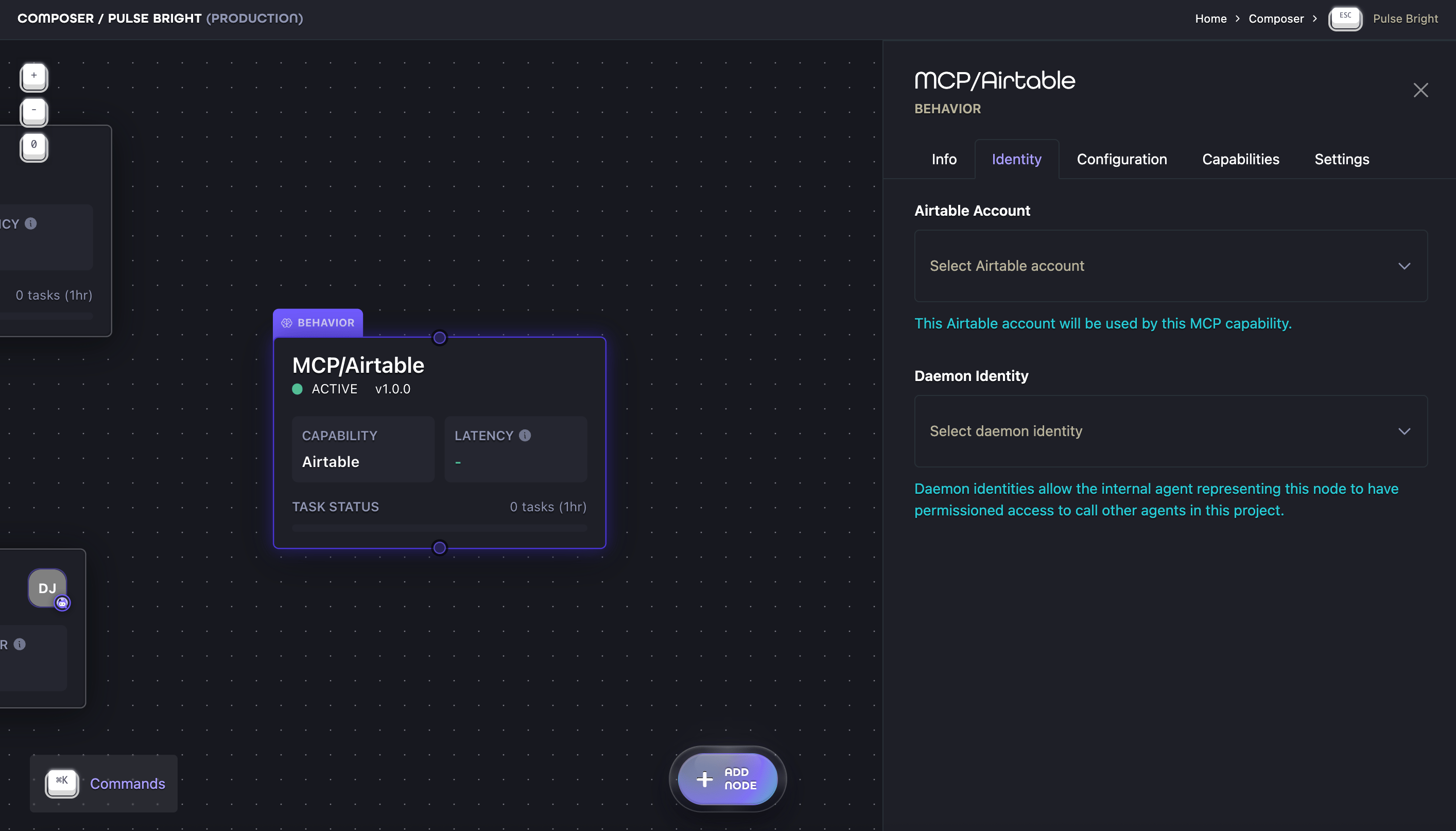
Agent-specific configuration
Under Agent environment, the Configuration tab shows fields that configure the agent runtime. The implementation defines those fields, so they vary by Behavior Ion. Use them to supply values such as instructions, limits, or provider settings. For example, the Prompt Agent Behavior Ion provides fields for its model, name, description, and system prompt: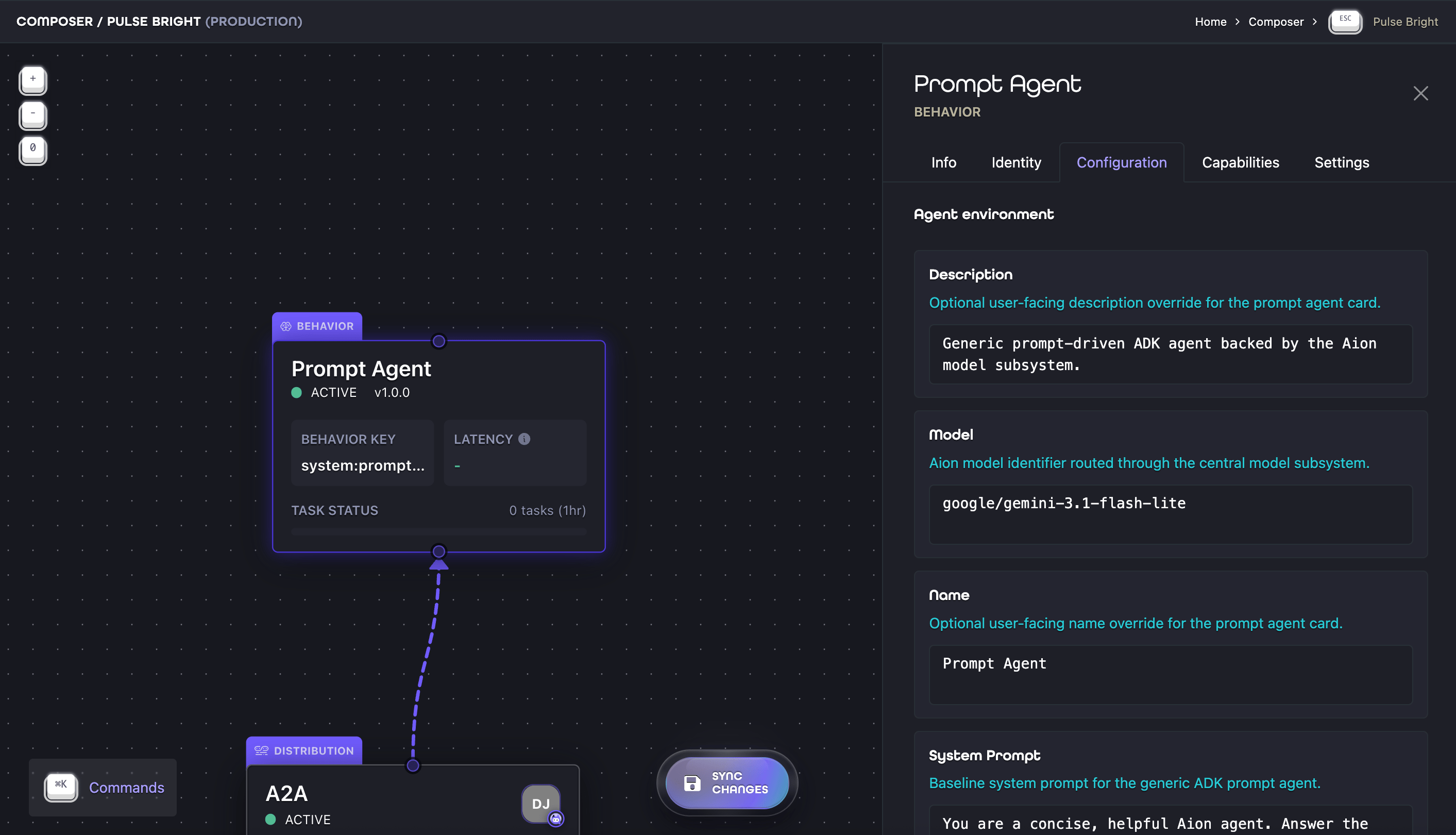
Secret configuration fields
Agent implementations can expose write-only secret fields in the Configuration tab. See Secret Fields for the supported schema and runtime handling. Authentication remains in the Identity tab. Use the Capabilities tab to enable or disable capabilities, choose a primary capability, and open any capability-specific settings.Capabilities
The implementation declares the agent, MCP, and event capabilities it supports. In the Capabilities tab, you can:- enable or disable a supported capability
- choose the primary capability when the implementation declares more than one of the same kind
- inspect which capabilities still require configuration or authentication
Versions and release channels
A Behavior Ion follows a release channel, not a fixed version. The Deployment Ion owns the available versions and marks which one is Stable and which one is Beta. The Behavior Ion’s Settings tab selects which channel to follow.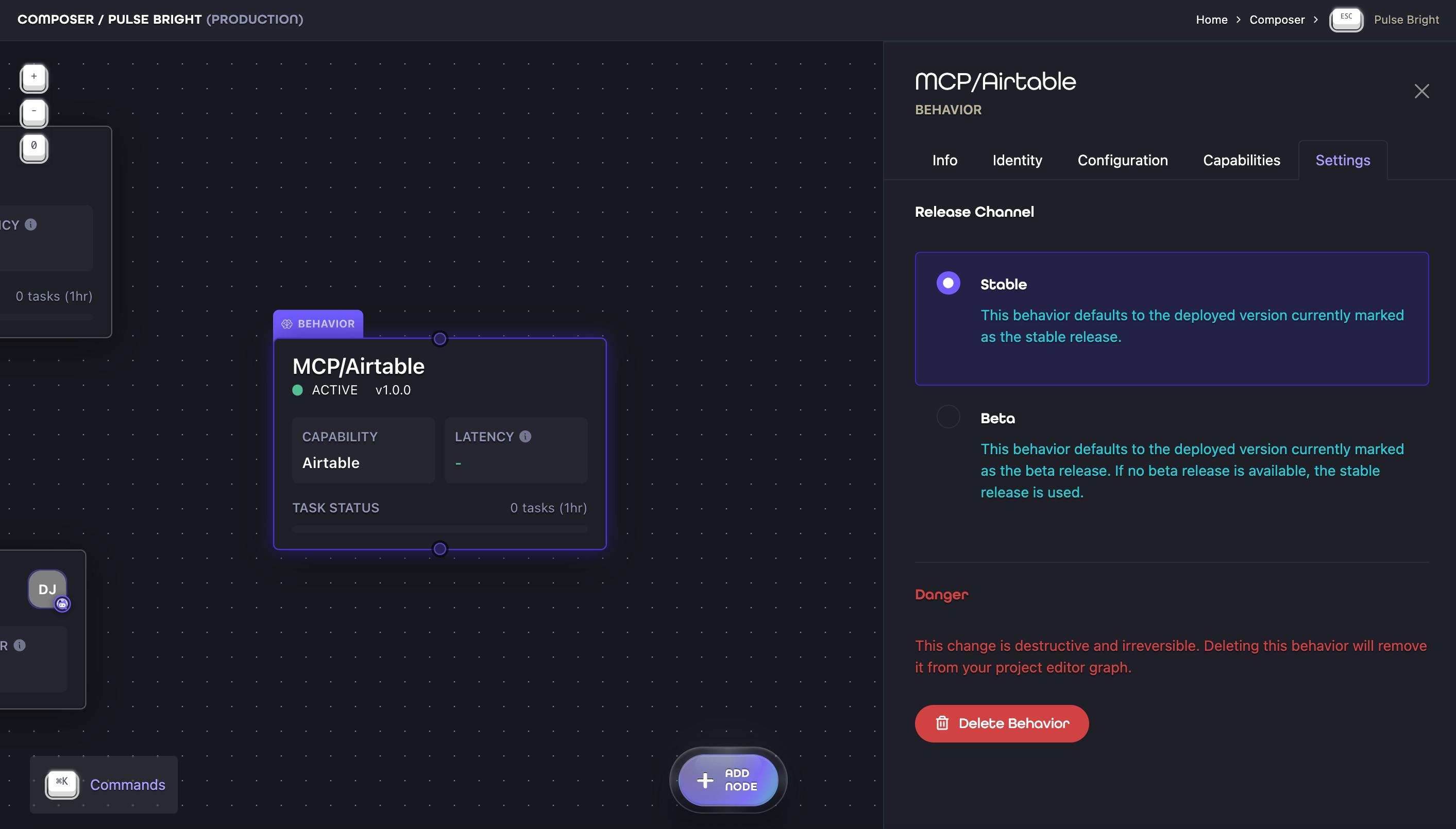
When a different version is promoted to the selected channel, the Behavior Ion resolves to the corresponding
implementation in that version without being recreated or reconnected in Composer. This lets you move an
implementation from Beta to Stable while keeping the Project graph unchanged.
The selected version must still provide the same registered implementation. If it does not, the Behavior Ion cannot
resolve and the Info tab reports that the Behavior is unavailable. Promote a compatible version or choose another
Behavior Ion to restore it.
See Versions and release channels to learn how
Deployment Ions manage the versions behind these selections.
Execution Scope and Identity
A Behavior Ion can participate in externally initiated work without becoming a public endpoint. Requests enter and return through a Distribution Ion. When the agent runtime associated with a Behavior Ion performs internal work outside a request flow initiated by a Distribution Ion, it can act under its own Daemon Identity. Aion attributes the work to that Identity and uses it for permission checks, billing, and audit context. A Daemon Identity is required when the runtime needs to communicate with other Aions in the same Project. It is the authorization principal Aion uses to determine what the runtime may access elsewhere in the Project or organization. Its roles and contextual permissions define that execution scope. See Environment boundaries for how Project, organization, and environment boundaries affect that scope.What to do next
- To understand the shared service surfaces an Ion can carry, read Capabilities.
- To understand public ingress, read Distribution Ions.
- To understand internal acting principals, read Daemon identities.
- To configure an Ion visually, read Composer.