

The three Ion categories
Choose an Ion category by the responsibility it has in the application:
The category describes the Ion’s job, not every interface it exposes. Adding an agent, MCP, or event capability does
not create another Ion category.
Ions and Sequences
A Sequence is the ordered list of Ions used when work enters through a Distribution Ion. The request follows the Composer connections between Ions that have an enabled A2A Sequence capability. Other Project-graph relationships can connect Ions without placing them in the request flow. Read the graph from either Distribution Ion:- Slack Sequence: Slack → Policy → Support
- A2A Sequence: A2A → Policy → Support
- add a Distribution Ion for another network without duplicating application behavior
- reuse a Behavior Ion across several Sequences
- update a Deployment Ion without redesigning the application’s network entrypoints
a2a.sequence enabled and selected as its primary A2A Sequence capability:
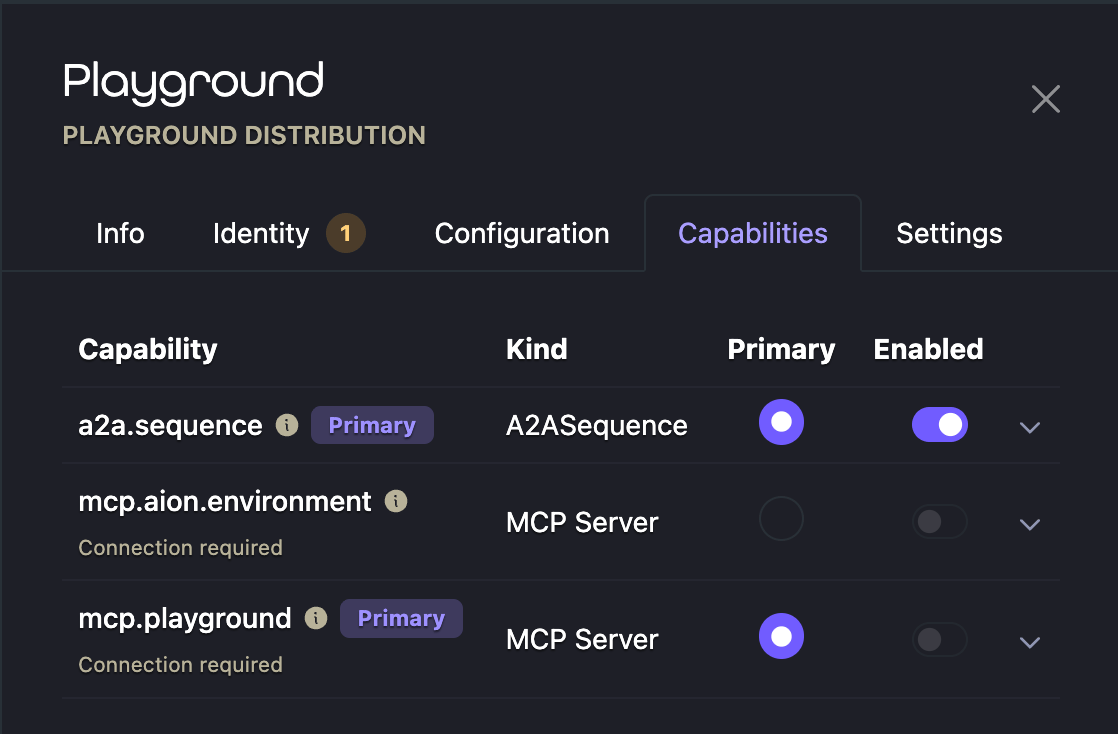
Capabilities
A capability is a service surface an Ion can make available as part of its job. An Ion is not an AI agent; it is the building block that groups the capabilities and configuration needed for one job. An agent is simply one capability of an Ion, exposed through A2A.
An implementation declares the capabilities it supports. The Ion’s runtime configuration determines which supported
capabilities are enabled and supplies any settings or authentication they require.
An Ion can carry one capability, combine several, or expose none. Its category still describes the goal it serves:
Distribution, Behavior, or Deployment.
Ions, Projects, and Aions
Ions live in Project graphs. A Project stores the Ions, their connections, and the configuration used to work on them together. A Project is not an Aion. An Aion follows its Identity, while Projects organize the Ions used to implement it:- One Project can contain Ions serving several Aion Identities.
- One Aion can use Ions and Sequences assembled in more than one Project.
What to do next
- To create and connect Ions, follow Build an Aion.
- To understand the visual editing workflow, read Composer.
- To design network ingress, read Distribution Ions.
- To add reusable application logic, read Behavior Ions.
- To make an implementation available, read Deployment Ions.